Inside the Sequence of a Card Shoe
Learn how a card shoe supports a prepared stack and presents the next card, so you can describe its role clearly without confusing it with a shuffler.
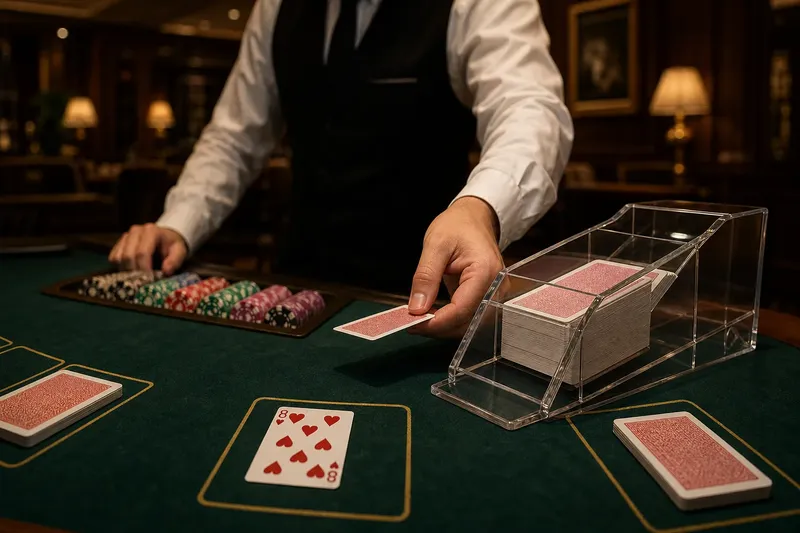
A card shoe holds a prepared stack beside the dealer and presents cards for dealing. To understand the sequence of a card shoe, trace how cards are prepared, loaded, accessed, and moved into the game; the holder supports that route but does not shuffle or choose cards.
For students at Trường Cao đẳng Bách khoa, the shoe is a useful object for studying how a component shapes a table routine. Focus on the visible structure and handling path, then distinguish what the device does from what the game’s procedure decides.
Which parts shape the card’s path?
Start with the shoe’s body, opening, supported stack, and any visible guide or stop. The body holds the cards in position; the opening gives the dealer access to an edge or end of the stack. Design details vary, so describe only the features you can actually see.
The card’s route has a clear boundary: it enters as part of a prepared supply, becomes accessible at the shoe, and leaves when the dealer draws it. The destination after that depends on the dealing routine, not on the holder alone.
Use this quick inspection list. For each item, record the observation and make the decision indicated by what you see:
- Opening: Check which side exposes the cards. If the opening is clear, mark that side as the access point; if it is obscured, leave the access direction unknown.
- Stack support: Check whether the body supports the cards along the base, sides, or both. If the support is visible, describe it; if part is hidden, do not infer the unseen structure.
- Card orientation: Check which edge faces the opening. If it is visible, draw that orientation; if not, label the orientation unconfirmed.
- Dealer’s reach: Check where the hand approaches the shoe in an authorized demonstration. If the reach is visible, mark the access point; if no handling is shown, omit a hand path.
- Card movement: Check whether one card or a group is removed in the observed action. If one card is shown, record a single-card draw; if the view is unclear, describe only that a card leaves.
- Next destination: Check where the removed card goes. If the destination is shown, label it; if it is outside the frame, mark it “not shown” rather than guessing.
- Visible stack: Check how much of the remaining stack can be seen from the viewing position. If the cards are visible, note what can be inspected; if blocked, record that the shoe obscures them from that angle.
How do you trace the sequence accurately?
Use four points: preparation, loading, access, and destination. Preparation and loading may not be visible in a demonstration, so mark them as unknown when the source does not show them. The shoe’s contribution is clearest at access: it supports the prepared cards and makes the next one reachable.
- Identify the prepared supply only if the source establishes that the cards were prepared.
- Record how the stack sits in the shoe if its orientation is visible.
- Mark the opening and the point where the dealer reaches for a card.
- Follow the card after it leaves, stopping at the last destination actually shown.
Say a classroom demonstration begins with a prepared stack beside a transparent shoe, shows the instructor placing the stack in the holder, and then shows one card drawn to a marked player position. Record those three actions in order: the stack is prepared, it is loaded with its accessible edge facing the opening, and one card is drawn to the marked position. The result is a concise account of the demonstrated route; it does not establish how a different game prepares or deals its cards.
What changes between shoe-based and hand dealing?
With a shoe, the prepared supply rests in a holder and the dealer reaches to that fixed position. In hand dealing, the dealer holds or manages the cards directly, so the supply and access point move with the hand. Compare those arrangements by noting where the cards rest and how the next card is reached, rather than treating one method as inherently better.
Game procedure determines when a card is dealt and where it goes. A shoe does not set those rules, and a familiar-looking holder is not proof that every table uses the same loading direction or sequence.
What details are worth recording?
A side-view sketch and a top-view sketch can make the arrangement easier to explain. Mark the opening, the supported stack, the dealer’s access point if shown, and the card’s next position if visible; use a note such as “destination not shown” where the view ends.
It is not worth the effort to infer hidden mechanisms from an exterior photograph or to describe decorative finishes that do not clarify the card’s route. If a detail depends on a specific game rule, venue procedure, or manufacturer instruction, consult the relevant source instead of generalizing from appearance.
What should students know about a card shoe?
Does a card shoe shuffle cards?
No. A card shoe holds cards that have been prepared for the dealing procedure; it does not shuffle them.
Why use a shoe instead of holding the stack?
A shoe supports the prepared supply in a fixed position and gives the dealer access to a card. The game’s procedure still determines when and where that card is dealt.
Can the same shoe be used for every game?
Do not assume that one device or loading routine fits every game. Identify the actual shoe and check the applicable procedure before describing its use.
What should a student draw first?
Draw the shoe’s visible outline, opening, and stack orientation. Add the card’s route only where the source shows it, and mark unseen parts as unknown.
How can you describe the shoe without overstating its role?
Choose verbs tied to visible actions: “holds,” “supports,” “presents,” and “draws.” Avoid saying the shoe controls the game or determines card order; those claims confuse a holder with the preparation and dealing procedures around it.
A clear account of the sequence of a card shoe names what happens before the shoe, what the holder makes accessible, and where observation ends. That boundary is useful in class: it lets readers understand the component while keeping the game-specific procedure open for separate study.